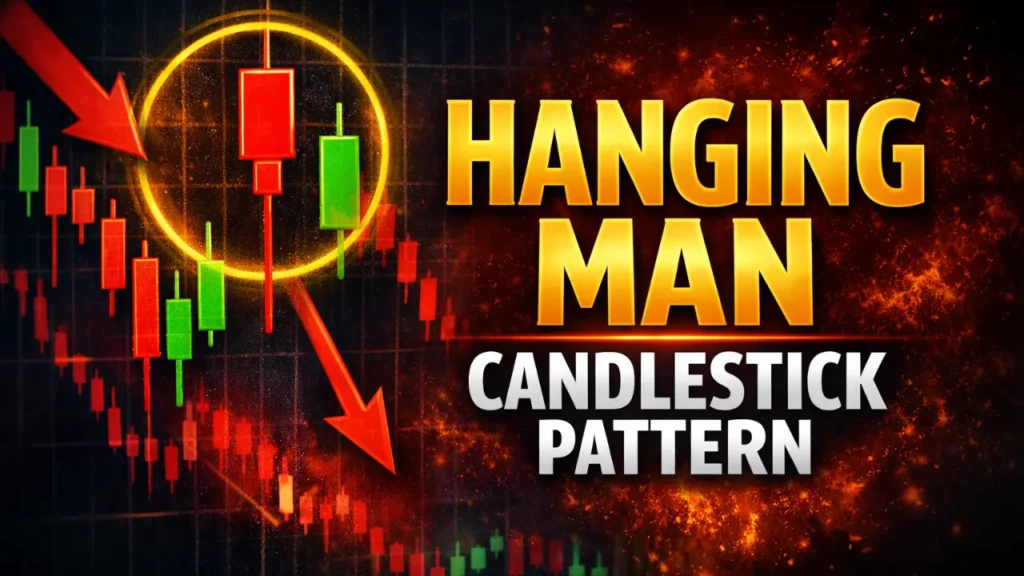
The Hanging Man Candlestick Pattern is a key bearish reversal pattern used in technical analysis, often appearing at the end of a strong uptrend. The primary purpose of this pattern is to warn traders that buyer strength is weakening and a sell-off could begin at any time.
This pattern is called a “hanging man” because its shape on the chart resembles a hanging body, with a short upper body and a long lower shadow. When this pattern forms at higher levels, especially near resistance or an overbought zone, it is considered a serious signal of a potential trend reversal.
Structure and Identification
Understanding the structure of the Hanging Man candle is essential for every technical trader, as without proper identification, its signal cannot be considered reliable. The real body of this candle is relatively small, indicating that there was not much difference between the open and close, meaning the upward rally was not sustainable. Additionally, a long downward shadow indicates that heavy selling occurred at some point during the same session, pushing prices significantly lower.
The upper shadow is either very short or almost nonexistent, indicating that significant buying activity at higher levels was absent during the session. If the candle is red or dark, the signal is even stronger, as it indicates that the close was below the open, and sellers ultimately dominated. The essence of this structure is that buyers’ confidence at higher levels is waning, and market pressure is increasing.
Importance in an Uptrend
The Hanging Man candlestick pattern is only considered significant when it forms after a clear uptrend, i.e., a series of consecutive higher highs and higher lows have been observed in prices. If this same candle appears in a downtrend or sideways market, it is not considered a hanging man, but rather, due to its similar structure, it often takes on a hammer-like interpretation.
When this pattern forms at a higher level after a prolonged uptrend, it signals the possibility of intense profit-booking or renewed selling. Prices open from a high and then pull back, and even if some recovery is seen at the end of the session, the long lower shadow on the chart reminds us that sellers have made their presence felt. Many experienced traders observe the price action of the next one or two sessions after this candle to determine whether the trend is truly about to reverse or if it is merely a temporary blip.
Hanging Man vs Hammer
Both the hanging man and the hammer are similar-looking candlestick patterns, with a short body and a long lower shadow. However, their context and signals are completely opposite. A hammer candlestick typically forms at the bottom of a downtrend and is considered a signal of a potential bullish reversal, while a hanging man, forming at the top of an uptrend, indicates a potential bearish one.
Since the two patterns appear to be nearly identical, new traders often confuse them and misread signals at the wrong level, potentially impacting trading decisions. The correct approach is to consider not just the shape of the candle, but also its location, the preceding trend, and surrounding support and resistance levels. Depending on the context, the same candle can become a hammer at times and a hanging man at others, completely changing the price action narrative.
Practical Trading Strategies
The hanging man candlestick pattern, by itself, is merely a warning, so savvy traders combine it with additional confirmatory signals rather than using it alone. When this pattern forms after a significant resistance, an overbought indicator level, or the climax of a long-term uptrend, its reliability increases significantly. If prices subsequently drop below the pattern’s low in the next candle or form a strong bearish candle, many traders decide to book partial or full profits.
Disclaimer
This article is for educational and informational purposes only. It is not any investment advice. Before making any investment-related decision, make sure to consult your financial advisor.